
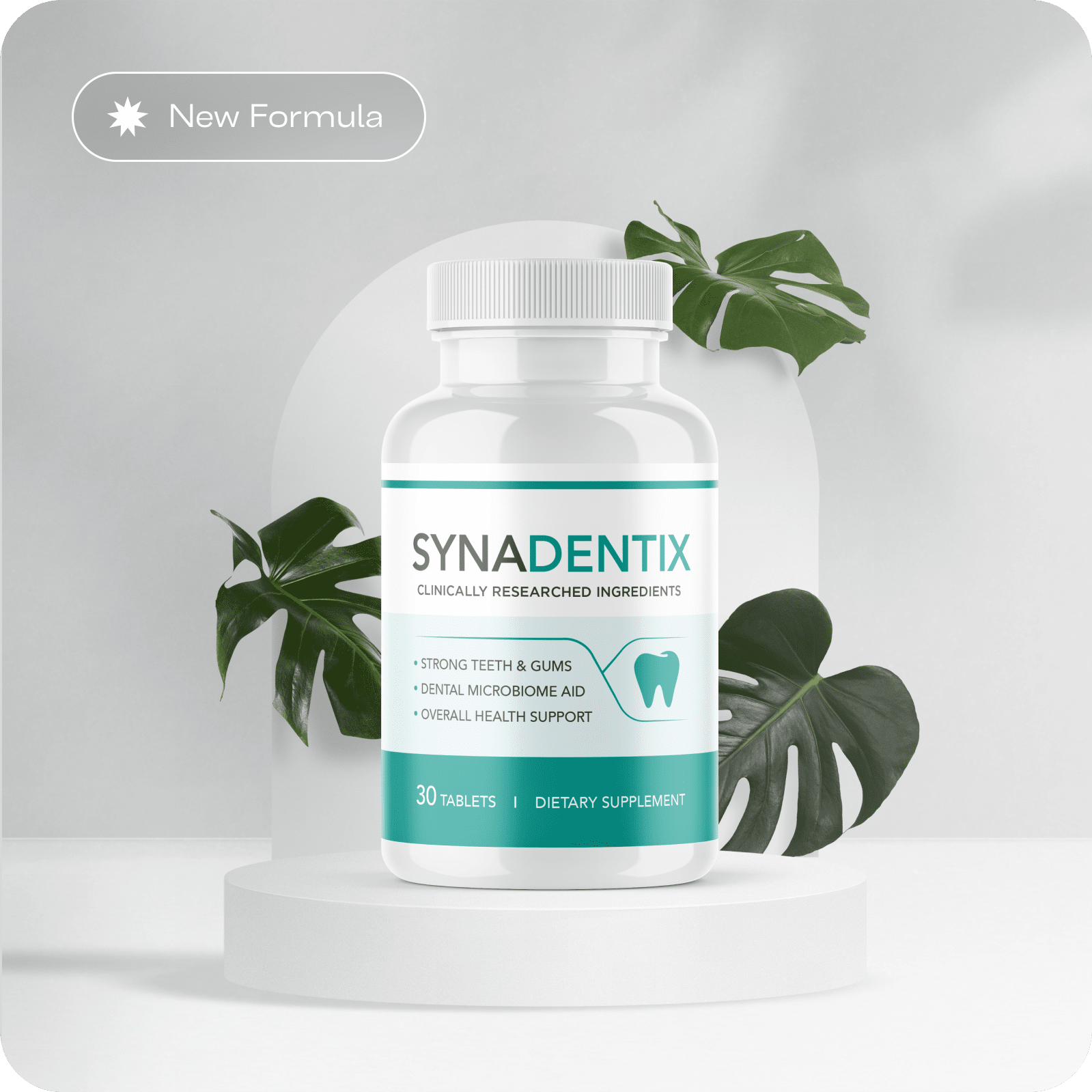
Synadentix
A nightly chewable built around enzymes and hydroxyapatite for oral microbiome support
Synadentix is a chewable supplement taken before bed that combines ten enzymes, minerals, and a botanical extract intended to work alongside saliva while you sleep. It is designed as a complement to brushing and flossing, not a replacement for them, and it has not been evaluated by the FDA to diagnose, treat, or cure any condition.
The formula centers on microcrystalline hydroxyapatite — the mineral that makes up most of tooth enamel — paired with enzymes such as beta-glucanase and dextranase that are studied in laboratory settings for breaking down dental biofilm, plus lactoferrin and lactoperoxidase, two antimicrobial proteins naturally present in human saliva.
Visit Official Website| Product | Synadentix — chewable oral microbiome supplement |
|---|---|
| Format | Chewable tablet, taken once nightly |
| Core ingredients | Microcrystalline hydroxyapatite, guava fruit powder, and eight enzymes/proteins including lactoferrin and lysozyme |
| Stated use case | Support for oral microbiome balance, enamel strength, and gum comfort, alongside normal brushing and flossing |
| Manufacturing | Per the manufacturer, produced in a US, GMP-registered facility |
| Guarantee | 90-day money-back guarantee, per the seller's stated policy |
| Where sold | Retailed through ClickBank via the official product site |
What is Synadentix, and what problem is it built to address?
Synadentix is a dietary supplement, not a drug, sold as a chewable tablet meant to be taken in the evening. The idea behind it is that the mouth hosts its own microbiome — a mix of bacteria that can either protect teeth and gums or contribute to plaque, cavities, and gum irritation depending on the balance between them. Synadentix combines minerals, enzymes, and a fruit-derived compound intended to support that balance, working alongside saliva rather than replacing brushing or flossing.
Saliva itself already does a version of this job: it buffers acid, clears food debris, and carries minerals that can redeposit onto enamel — a process called remineralization. Synadentix's core premise is to add ingredients to that overnight saliva flow that may support the same processes, rather than introducing a new mechanism entirely.
Why does Synadentix stand out from other oral health supplements?
Names its actives directly
Rather than a single unnamed "proprietary probiotic blend," Synadentix lists ten specific, established compounds by their scientific names, which makes it possible to look up independent research on each one.
Fluoride-free remineralization approach
It uses microcrystalline hydroxyapatite rather than fluoride as its remineralizing mineral — an approach some people prefer, though the two work through different mechanisms and aren't directly interchangeable.
No live probiotic strains
Unlike probiotic-first oral supplements, Synadentix relies on enzymes and minerals instead of introducing live bacterial strains — a different strategy for the same broad goal of microbiome balance.
What is in Synadentix, and why is each ingredient there?
Each Synadentix tablet combines ten ingredients across four categories: one mineral complex, one plant-derived compound, and eight enzymes and proteins. Below is what each one is, why it's included, and an honest read on the supporting evidence.
Microcrystalline Hydroxyapatite Complex
Hydroxyapatite is the mineral that makes up roughly 90% of tooth enamel by weight. The idea is to supply the same mineral enamel is built from, so it can be redeposited into worn or demineralized areas.
Why it's there: to support remineralization — rebuilding the tooth's outer mineral layer — and to reduce the exposed dentin that causes sensitivity.
Guava Fruit Powder
Guava fruit and leaf extracts contain polyphenols and tannins that have been studied in a general antimicrobial and antioxidant context.
Why it's there: as a plant-based component intended to complement the enzyme and mineral actives.
Beta-Glucanase
An enzyme that breaks down glucan polymers, a structural component of dental biofilm's sticky matrix.
Why it's there: to help loosen the matrix that holds plaque biofilm together.
Dextranase
Breaks down dextran, another sticky polysaccharide that bacteria like Streptococcus mutans use to build biofilm structure.
Why it's there: to target the biofilm scaffolding that lets cavity-causing bacteria adhere to teeth.
Amylase
A digestive enzyme that breaks down starches. In saliva, it's part of the normal process of clearing carbohydrate residue that bacteria could otherwise ferment into acid.
Why it's there: to support the mouth's existing starch-clearing process.
Lactoperoxidase
An enzyme naturally found in saliva that's part of the mouth's built-in antibacterial system, generating mild antimicrobial compounds from compounds already present in saliva.
Why it's there: to reinforce an antimicrobial pathway the body already uses.
Glucose Oxidase
An enzyme that converts glucose into byproducts including hydrogen peroxide in small, controlled amounts, and is frequently paired with lactoperoxidase in oral-care formulations.
Why it's there: to help fuel the lactoperoxidase antimicrobial pathway.
Amyloglucosidase
Works alongside amylase, breaking starch fragments down further into simple sugars for clearance rather than fermentation.
Why it's there: to complete the starch-breakdown process amylase begins.
Lysozyme
A well-characterized antimicrobial enzyme naturally present in saliva and tears, known for breaking down the cell walls of certain bacteria.
Why it's there: to add to the mouth's existing enzymatic defenses.
Lactoferrin
An iron-binding protein found in saliva that can limit the iron available to certain bacteria, indirectly restraining their growth, alongside broader immune-supporting roles.
Why it's there: to support the mouth's natural antimicrobial defenses and tissue health.
How does Synadentix work overnight?
Synadentix is taken as a chewable tablet before bed so its ingredients are present in the mouth during sleep, when saliva flow slows down but doesn't stop. The manufacturer's stated approach has three stages: loosening biofilm, reinforcing the mouth's antimicrobial proteins, and supplying minerals for remineralization.
Enzymes target biofilm structure
Beta-glucanase and dextranase are intended to break down the sticky glucan and dextran scaffolding that holds plaque biofilm onto tooth surfaces, based on laboratory biofilm-model research.
Salivary proteins reinforce defenses
Lactoferrin, lactoperoxidase, glucose oxidase, and lysozyme mirror antimicrobial proteins already present in human saliva, aiming to top up those natural defenses overnight.
Hydroxyapatite supports remineralization
With biofilm reduced, hydroxyapatite particles are positioned to help redeposit mineral into enamel — the same basic process topical hydroxyapatite toothpaste has been studied for.
Synadentix frequently asked questions
How does Synadentix work?
It combines enzymes that target plaque biofilm, proteins that mirror the mouth's own antimicrobial defenses, and hydroxyapatite mineral intended to support enamel remineralization — taken nightly so the ingredients are present during sleep.
What are the ingredients in Synadentix?
Ten total: microcrystalline hydroxyapatite complex, guava fruit powder, beta-glucanase, dextranase, amylase, lactoperoxidase, glucose oxidase, amyloglucosidase, lysozyme, and lactoferrin. Full detail on each is in the ingredients section above.
How do I use it?
The manufacturer's directions call for chewing one tablet nightly as part of an evening oral care routine, alongside — not instead of — regular brushing and flossing.
Is this a one-off purchase, or a subscription?
Bottles are sold in one-time packages of 2, 3, or 6 through the official site; it is not described as an auto-renewing subscription on the seller's order page.
What is the money-back guarantee?
The seller states a 90-day money-back guarantee: if you're not satisfied within that window, you can contact them for a refund, per their stated policy.
How many bottles should I order?
That depends on how long you intend to use it. The manufacturer prices multi-bottle bundles lower per unit, which is standard for this category, but a single bottle is enough to judge whether it suits your routine before committing further.
What does research say about oral bacteria and health beyond the mouth?
A growing body of research is examining Porphyromonas gingivalis, a bacterium associated with gum disease, for possible links to conditions outside the mouth. This is genuinely active science worth understanding on its own terms — separate from any single product.
A 2020 review discussed findings connecting P. gingivalis to Alzheimer's disease research (Ryder, 2020). A 2023 study in mice found that bacteremia from P. gingivalis could increase blood-brain barrier permeability through a specific cellular pathway (Lei et al., 2023), and a 2024 study examined how chronic oral inoculation with P. gingivalis and a related bacterium produced different brain pathologies in an Alzheimer's mouse model (Ciccotosto et al., 2024).
Full reference list
- Amaechi, B. T., Lemke, K. C., Saha, S., Luong, M. N., & Gelfond, J. (2021). Clinical efficacy of nanohydroxyapatite-containing toothpaste at relieving dentin hypersensitivity: An 8 weeks randomized control trial. BDJ Open, 7(23), 1–8.
- Bauer, J. A., Zámocká, M., Majtán, J., & Bauerová-Hlinková, V. (2022). Glucose oxidase, an enzyme "ferrari": Its structure, function, production and properties in the light of various industrial and biotechnological applications. Biomolecules, 12(3), 472.
- Berlutti, F., Pilloni, A., Pietropaoli, M., Polimeni, A., & Valenti, P. (2012). Lactoferrin and oral diseases: Current status and perspective in periodontitis. Annali Di Stomatologia, 2(3–4), 10–18.
- Ryder, M. I. (2020). Porphyromonas gingivalis and Alzheimer disease: Recent findings and potential therapies. Journal of Periodontology, 91(1), S45–S49.
- Farooq, I., & Bugshan, A. (2021). The role of salivary contents and modern technologies in the remineralization of dental enamel: A narrative review. F1000Research, 9, 171.
- Lei, S., Li, J., Yu, J., Li, F., Pan, Y., Chen, X., Ma, C., Zhao, W., & Tang, X. (2023). Porphyromonas gingivalis bacteremia increases the permeability of the blood-brain barrier via the Mfsd2a/Caveolin-1 mediated transcytosis pathway. International Journal of Oral Science, 15(1), 1–12.
- Liu, N., Li, X., Wang, M., Zhang, F., Wang, C., Zhang, K., Wang, H., Xu, S., Hu, W., & Gu, L. (2021). DexA70, the truncated form of a self-produced dextranase, effectively disrupts Streptococcus mutans biofilm. Frontiers in Microbiology, 12, 737458.
- Magacz, M., Kędziora, K., Sapa, J., & Krzyściak, W. (2019). The significance of lactoperoxidase system in oral health: Application and efficacy in oral hygiene products. International Journal of Molecular Sciences, 20(6), 1443.
- Najibfard, K., Ramalingam, K., Chedjieu, I., & Amaechi, B. T. (2011). Remineralization of early caries by a nano-hydroxyapatite dentifrice. The Journal of Clinical Dentistry, 22(5), 139–143.
- Pepla, E., Besharat, L. K., Palaia, G., Tenore, G., & Migliau, G. (2014). Nano-hydroxyapatite and its applications in preventive, restorative and regenerative dentistry: A review of literature. Annali Di Stomatologia, 5(3), 108–114.
- Rikvold, P. D., Benedicte, L., Meyer, R. L., Jørgensen, M. R., Tiwari, M. K., & Schlafer, S. (2023). The effect of enzymatic treatment with mutanase, beta-glucanase, and DNase on a saliva-derived biofilm model. Caries Research, 58(2), 72–80.
- Ciccotosto, G. D., Mohammed, A. I., Paolini, R., Bijlsma, E., Toulson, S., Holden, J., Reynolds, E. C., Dashper, S. G., & Butler, C. A. (2024). Chronic oral inoculation of Porphyromonas gingivalis and Treponema denticola induce different brain pathologies in a mouse model of Alzheimer disease. The Journal of Infectious Diseases, 230(2), S109–S116.
Related educational reading
Understanding Gum Disease (NIDCR)
A plain-language overview of gum disease causes and prevention from the National Institute of Dental and Craniofacial Research.
How Saliva Protects Your Teeth (ADA)
The American Dental Association's consumer resource on saliva's natural role in oral health.
Synadentix Ingredient Breakdown
Jump back to the full ingredient-by-ingredient explanation and evidence review on this page.
Oral-Systemic Health Research
Read the research spotlight above on oral bacteria and its studied links to health outside the mouth.