
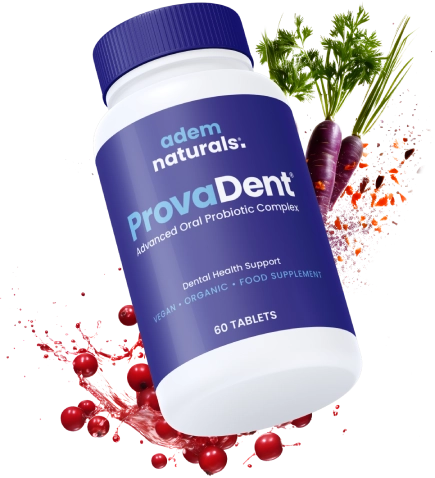
ProvaDent oral health supplement bottle with capsules for gum and tooth support

ProvaDent

What the research actually says about this oral‑health supplement

ProvaDent is a daily capsule supplement marketed for oral microbiome support, combining xylitol, a cranberry-derived extract, purple carrot powder, and four probiotic strains. This page walks through each ingredient's published research so you can weigh the evidence yourself before buying.

Advertising disclosure: this page contains affiliate links. We may earn a commission if you purchase through them, at no extra cost to you. This is not medical advice, and ProvaDent has not been evaluated by the FDA to diagnose, treat, cure, or prevent any disease.

Quick overview
ProductProvaDent — oral health capsule supplement
FormOral capsule, taken daily with water
Key ingredientsOrganic xylitol, BioFresh™ Clean Complex, cranberry extract, purple carrot powder, a 4-strain probiotic blend
Stated purposeMarketed to support a balanced oral microbiome, fresh breath, and general oral wellness
Clinical trials on the finished formulaNone found in peer-reviewed literature at time of writing — evidence below relates to individual ingredients, not the ProvaDent formula itself
Where to buyOfficial product page (affiliate link)
What is ProvaDent?

What is ProvaDent, and what is it meant to do?

ProvaDent is a dietary supplement sold as daily capsules that combine a sugar alcohol (xylitol), a polyphenol-rich cranberry extract, purple carrot powder, a proprietary "BioFresh™" ingredient blend, and four bacterial probiotic strains. It's marketed as a way to support the balance of bacteria in the mouth rather than to treat a specific dental disease.

Like most oral-care supplements in this category, ProvaDent sits in a crowded field of similarly-formulated products (ProDentim, Purdentix, and others use comparable ingredient lists). None of them, including ProvaDent, currently have a published, peer-reviewed clinical trial testing the finished capsule in humans. That doesn't automatically mean the product does nothing — several of its individual ingredients do have real research behind them, covered in detail below — but it does mean that any claim about "ProvaDent" specifically curing, reversing, or treating dental disease goes beyond what's been demonstrated.

If you see marketing elsewhere claiming ProvaDent can "regrow gums," "rebuild teeth," or "eliminate the need for fillings," treat that skeptically — no oral supplement, including this one, has that kind of evidence, and the FDA does not evaluate dietary supplements for disease treatment claims.

A quick way to think about it

Supplements like ProvaDent are best understood as adjuncts to — not replacements for — brushing, flossing, and regular dental visits. The research on ingredients like xylitol and probiotics is genuinely encouraging for that supporting role; it just doesn't extend to replacing dental care.

Formulation

Why ProvaDent's ingredient choices are worth a closer look

ProvaDent's formulation is notable mainly because it leans on ingredient categories — xylitol, cranberry polyphenols, and multi-strain probiotics — that each have independent published research in oral biology, rather than a single novel patented compound. That's a reasonable approach for a supplement, though it also means ProvaDent's value depends heavily on dose, strain identity, and manufacturing quality, none of which are independently verified by a third party as of this writing.

Two things would meaningfully strengthen the case for ProvaDent specifically: (1) public disclosure of the exact probiotic strains and CFU counts in the "4 strains of probiotics" blend, since research on oral probiotics is highly strain-specific — a strain shown to reduce bad breath (like S. salivarius K12) doesn't tell you anything about an unnamed strain; and (2) a published trial of the finished capsule, not just its individual components.

Ingredient science

ProvaDent ingredients, explained one at a time

For each ingredient in ProvaDent: what it is, why a formulator would include it, what the actual research shows, and a plain verdict.

🦷
Sweetener / anti-cariogenic

Organic Xylitol

Xylitol is a naturally occurring sugar alcohol used as a low-calorie sweetener. It's included in ProvaDent because, unlike sugar, xylitol cannot be metabolized by the cavity-causing bacterium Streptococcus mutans, which starves the bacteria that drive tooth decay instead of feeding them.

Why it's there: to sweeten the capsule without contributing to the sugar-feeding cycle that lets cariogenic bacteria thrive, and because xylitol itself appears to directly suppress those bacteria.

What the research shows: Xylitol has more human clinical evidence behind it than almost any other ingredient in this category. A large three-year randomized controlled trial (X-ACT) found daily xylitol lozenges (up to 5g/day) reduced cavitated caries lesions in adults compared to placebo. A secondary analysis of that same trial examined whether xylitol lozenges had different effects across different tooth surfaces in participants followed at baseline and at 12, 24, and 33 months. Separately, clinical research chewing xylitol gum (about 6.2 g of xylitol per day) has been shown to reduce cariogenic and periodontal bacteria in dental plaque. A more recent systematic review concluded that a clinically meaningful caries-reducing effect of xylitol gum has been well demonstrated specifically in children and adolescents who already have a high or moderate caries risk — the benefit is less clear-cut in low-risk populations.

Verdict: The strongest-evidenced ingredient in the formula. The catch: ProvaDent's capsules deliver a fraction of the 5g/day dose used in the trials above, and the mechanism (sustained contact with teeth from lozenges/gum) doesn't fully translate to a swallowed capsule.

Sources: X-ACT trial, JADA · Tooth-surface analysis, PubMed · Plaque microbiome study, PMC · Systematic review, Eur Arch Paediatr Dent

🧪
Proprietary blend

BioFresh™ Clean Complex

This is described only as a proprietary blend on ProvaDent's packaging, without its individual components or amounts disclosed publicly.

Why it's there: presumably to support breath freshness and a "clean" oral environment, per the marketing description — but without an ingredient breakdown, that can't be independently verified against research.

What the research shows: Nothing specific — proprietary blends without disclosed ingredient lists can't be matched to any published study, because there's no way to know what's actually in them or at what dose.

Verdict: Unratable as written. If oral-microbiome research matters to your decision, this is the one part of the label worth asking the manufacturer to disclose in full before buying.
🫐
Polyphenol extract

Cranberry Extract

Cranberry extract is rich in proanthocyanidins, plant compounds studied for their ability to interfere with how cariogenic bacteria stick to tooth surfaces and to each other.

Why it's there: cranberry polyphenols are one of the better-studied "anti-adhesion" agents in oral biology — the theory is that bacteria that can't attach to teeth can't build the biofilm that leads to decay and gum disease.

What the research shows: In vitro work has found cranberry extract reduced pre-formed S. mutans and L. acidophilus biofilm by around 50% in laboratory testing, with bactericidal and bacteriostatic effects that scaled with dose and exposure time. Against periodontal pathogens specifically, one study found a cranberry extract inhibited colonization of six tested bacterial species in an in-vitro biofilm model, with especially large reductions for P. gingivalis, A. actinomycetemcomitans, and F. nucleatum. On the clinical side, a systematic review concluded that cranberry-based mouthwashes and gels have shown efficacy in inhibiting bacterial adhesion and biofilm formation, positioning cranberry as a promising natural alternative to conventional antimicrobial oral-care products. A recent randomized trial in children even found a cranberry-extract mouthwash performed comparably to a fluoride mouthwash at reducing S. mutans counts, though that compared a topical rinse, not an ingested capsule.

Verdict: Genuinely promising research — but almost entirely from mouthwashes, gels, or juice with direct, repeated tooth contact. A swallowed capsule doesn't bathe the teeth the way a rinse does, so the anti-adhesion effect shown in these studies may not transfer directly.

Sources: Antibiofilm study, PMC · Periodontal pathogen study, PMC · Systematic review, GJMPBU · JCDA review

🥕
Whole-food powder

Purple Carrot Powder

Purple carrots are a source of anthocyanins (the same antioxidant pigment family found in blueberries and purple potatoes) plus general carrot nutrients like beta-carotene and fiber.

Why it's there: most likely as a general antioxidant/micronutrient addition and possibly a natural colorant, rather than a targeted oral-health mechanism.

What the research shows: There is a body of general nutrition and antioxidant research on purple carrots and anthocyanins, but we could not find dental- or oral-microbiome-specific clinical research on purple carrot powder itself. Its inclusion appears to be a general-wellness addition rather than an oral-health-targeted one.

Verdict: Plausible as a general nutritional add-in; not supported by oral-health-specific evidence at this time.
🦠
Live cultures

4 Strains of Probiotics

ProvaDent includes a blend described as four probiotic strains intended to support a healthy balance of oral bacteria, though the specific species and CFU counts are not listed in the product description we reviewed.

Why it's there: oral probiotics work by competing with harmful bacteria for space and nutrients, and by producing antimicrobial compounds that suppress pathogens directly — the theory is "crowding out" bad bacteria with beneficial ones rather than killing everything indiscriminately the way an antiseptic mouthwash does.

What the research shows: This is the most strain-dependent category in the whole formula. Some named strains have real backing: Streptococcus salivarius K12 has shown antimicrobial and antibiofilm activity against oral pathogens in laboratory testing, including significantly reduced growth of S. mutans, and it's one of the more commonly cited oral probiotics alongside Lactobacillus reuteri and Lactobacillus rhamnosus GG. Screening studies have also identified specific candidate strains — for example, researchers screened 14 lactobacillus strains and 36 streptococcus strains out of 896 oral isolates from healthy people to find ones with antibacterial activity and no harmful side effects. Other in-vitro work found certain Lactobacillus strains' cell-free supernatants outperformed Bifidobacterium against oral pathogens, and a characterized Lactobacillus brevis strain showed antimicrobial activity against S. mutans and was able to adhere to oral epithelial cells.

The catch: none of that research applies to "four strains of probiotics" as an unnamed category — it applies to specific, named strains at specific doses. Without ProvaDent disclosing which four strains it uses, this evidence can inform what a good oral probiotic blend generally looks like, but it can't confirm what's in this particular bottle.

Verdict: The concept is well-supported by research on named strains. ProvaDent's specific formulation can't be evaluated against that research until the strains are disclosed.

Sources: S. salivarius K12 study, PMC · Strain screening, PLOS ONE · Lactobacillus/Bifidobacterium comparison, PMC · L. brevis characterization, PMC

Mechanism

How ProvaDent is intended to work

ProvaDent's ingredients target three stages of oral bacterial activity: preventing bacteria from sticking to teeth, rebalancing which bacteria dominate the mouth, and reducing the fuel (fermentable sugar) available to harmful species. Here's how those three stages line up with the formula.

1

Reduce bacterial fuel

Xylitol replaces fermentable sugar, so cariogenic bacteria like S. mutans can't use it for energy or acid production — research on lozenges and gum shows this can measurably shift plaque bacteria over weeks.

2

Block bacterial adhesion

Cranberry polyphenols are studied for interfering with how bacteria attach to tooth surfaces and to each other — most evidence comes from direct-contact formats like mouthwash, less is known about a swallowed capsule.

3

Rebalance the microbiome

Probiotic strains aim to occupy space and produce antimicrobial compounds that keep harmful bacteria from dominating — well-documented for specific named strains, unverified for ProvaDent's undisclosed blend.

FAQ

ProvaDent FAQs

Is ProvaDent backed by clinical trials?

Is ProvaDent backed by clinical trials? No — at the time of writing, there is no published, peer-reviewed clinical trial testing the finished ProvaDent capsule in humans. Several individual ingredients (xylitol, cranberry extract, certain probiotic strains) do have their own published research, which is covered ingredient-by-ingredient above.

What are ProvaDent's main ingredients?

What are ProvaDent's main ingredients? ProvaDent's label lists organic xylitol, a proprietary "BioFresh™ Clean Complex," cranberry extract, purple carrot powder, and a blend of four probiotic strains. The specific probiotic species and their amounts are not disclosed in the product description we reviewed.

Can ProvaDent replace brushing, flossing, or dental visits?

Can ProvaDent replace brushing, flossing, or dental visits? No. Nothing in the published research on any of ProvaDent's ingredients supports replacing basic oral hygiene or professional dental care. At best, ingredients like xylitol and cranberry extract are studied as additions alongside standard care, not substitutes for it.

Are there known side effects of ProvaDent's ingredients?

Are there known side effects of ProvaDent's ingredients? Xylitol in high doses (well above what a typical capsule contains) can cause digestive upset, and is toxic to dogs, so keep it away from pets. Cranberry extract and probiotics are generally well tolerated but can occasionally cause mild digestive discomfort in sensitive individuals. If you're pregnant, nursing, taking medication, or have a medical condition, talk to a doctor or dentist before starting any new supplement.

Why doesn't ProvaDent disclose its exact probiotic strains?

Why doesn't ProvaDent disclose its exact probiotic strains? That information isn't included in the product description available at the time of writing. Oral probiotic research is strain-specific, so without knowing exactly which four strains are used, the general research on named strains like S. salivarius K12 can't be applied directly to this product.

Where can I buy ProvaDent safely?

Where can I buy ProvaDent safely? To avoid counterfeit or expired product, buy directly from the manufacturer's official site rather than third-party marketplaces. You can visit the official ProvaDent page through the link on this page.

Research summary

The research behind ProvaDent's ingredients, at a glance

This table separates what's been studied (the individual ingredients) from what hasn't (the finished ProvaDent formula). Full citations are linked in each ingredient section above.

IngredientStrength of human/clinical evidenceBest-supported claim
XylitolStrong — multiple RCTs, including a 33-month multicenter trialMay help reduce cariogenic bacteria and caries risk, especially in higher-risk individuals, at gum/lozenge doses of several grams per day
Cranberry extractModerate — mostly in-vitro plus some clinical mouthwash/juice trialsMay inhibit bacterial adhesion and biofilm formation; less known about a swallowed capsule format
Named oral probiotic strains (e.g., S. salivarius K12)Moderate — in-vitro and some clinical work on specific strainsMay help crowd out harmful bacteria and reduce bad-breath-associated species
ProvaDent's undisclosed 4-strain blendNot established — strains unnamedCannot be verified against existing strain-specific research
Purple carrot powderLimited — general nutrition research only, no oral-specific studies foundGeneral antioxidant/nutrient contribution
BioFresh™ Clean ComplexNot established — proprietary, ingredients undisclosedCannot be evaluated
ProvaDent (finished capsule)None found — no published clinical trial on the product itselfN/A

This summary reflects a review of publicly available peer-reviewed literature as of the time of writing and is not exhaustive. It is not medical advice.