
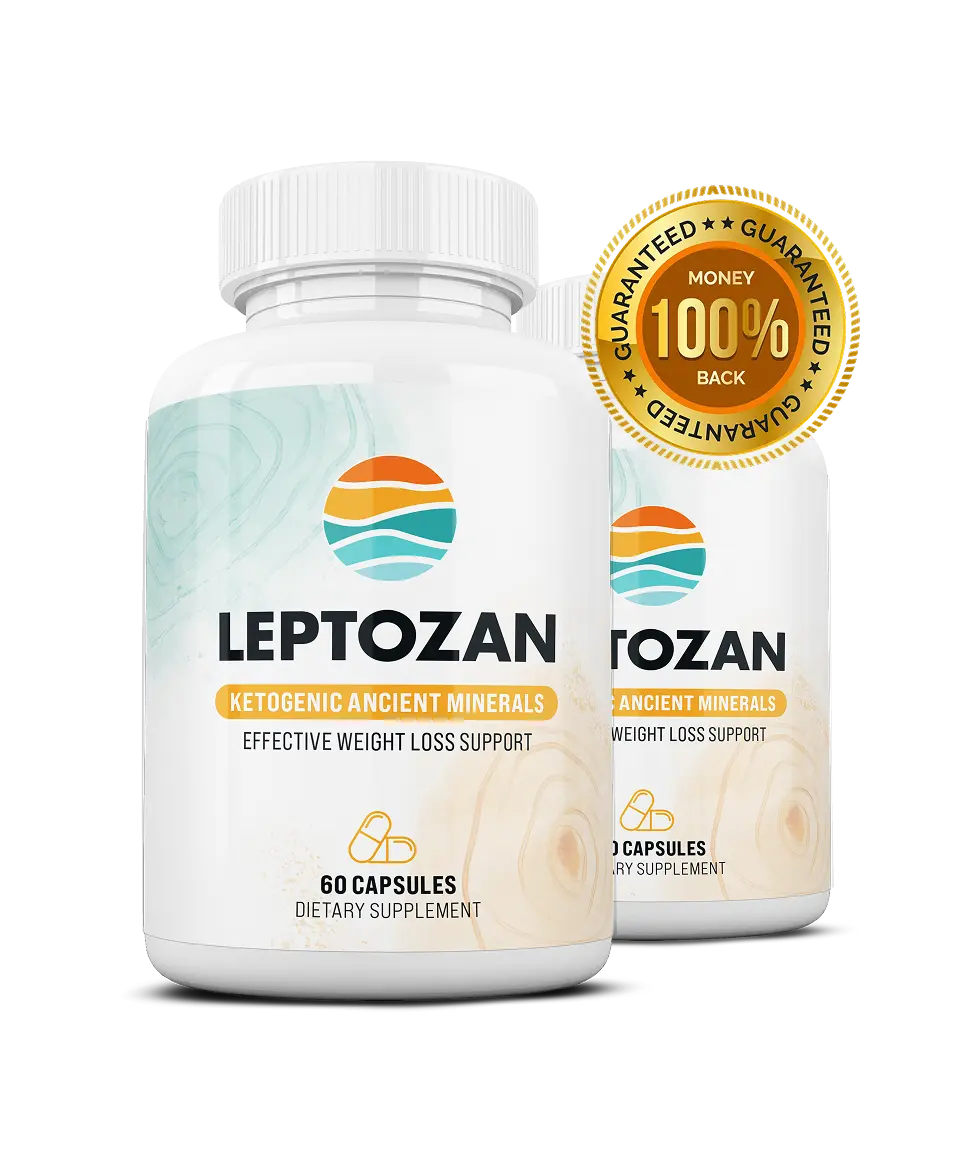
Leptozan supplement bottle with calcium, sodium and magnesium BHB salts on a light blue Dead Sea mineral background
Independent Ingredient Review

Leptozan

A closer look at its Dead Sea mineral BHB salt formula

Leptozan is a dietary supplement built around three exogenous ketone salts — calcium, sodium and magnesium beta-hydroxybutyrate (BHB) — minerals associated with Dead Sea salt sources. Exogenous BHB salts are well-studied for their ability to raise blood ketone levels within minutes of ingestion; the evidence for translating that into meaningful, lasting fat loss on their own is far thinner, and this page walks through both sides plainly.

Visit Official Website Always check the current label and price on the official site before buying.

Leptozan at a Glance

Here is the short version: Leptozan supplies three BHB mineral salts, is taken as a daily capsule or drink mix depending on the SKU you buy, and is marketed for energy and metabolic support rather than guaranteed weight loss. Exact serving size, capsule count and pricing vary by bundle, so confirm current specifics on the official order page rather than relying on secondhand figures.

Product nameLeptozan
Core ingredientsCalcium BHB, Sodium BHB, Magnesium BHB (exogenous ketone salts)
Ingredient originMineral salts associated with Dead Sea sources
Stated purposeSupport for energy metabolism and ketone-assisted metabolic function
Evidence levelWell-established for raising blood ketones acutely; limited and mixed for direct fat-loss claims
Who should check with a doctor firstAnyone pregnant, nursing, on blood pressure or diabetes medication, or with kidney or heart conditions (sodium load)
Regulatory statusDietary supplement — not evaluated by the FDA to diagnose, treat, cure or prevent disease

What Is Leptozan?

Leptozan is a supplement formulated around exogenous ketone salts rather than stimulants or appetite suppressants. Instead of asking the body to produce ketones through carbohydrate restriction, it delivers beta-hydroxybutyrate already bound to calcium, sodium and magnesium, so blood ketone levels can rise without a strict ketogenic diet.

This approach sits inside a broader category of products often called exogenous ketones or ketone esters. The mineral-salt form (as opposed to ketone esters) is the more common and more affordable version found in consumer supplements, and it's the form most of the human research below is based on.

Why Does Leptozan Use Three Different BHB Salts Instead of One?

Leptozan combines calcium, sodium and magnesium BHB rather than a single salt because each mineral carries its own secondary role beyond delivering ketones — calcium and magnesium support normal muscle and nerve function, while sodium helps with fluid balance during a lower-carbohydrate intake. Blending the three also keeps the dose of any one mineral lower than it would be if all the BHB came from a single salt.

That's the manufacturer's rationale for a blended salt; it is a reasonable formulation choice, though it does not by itself add evidence beyond what's known about BHB salts generally.

What Are Leptozan's Ingredients, and What Does the Research Say?

Leptozan's label centers on three exogenous ketone salts — calcium BHB, sodium BHB and magnesium BHB — each contributing beta-hydroxybutyrate plus one mineral. Below is what each component is for, why it's likely included, and a plain-language verdict on the evidence behind it.

Calcium Beta-Hydroxybutyrate

What it's for: Calcium BHB is the most common exogenous ketone salt used in supplements, chosen because calcium is well tolerated and helps bind BHB into a stable, swallowable form.

Why it's there: An 8-week randomized, placebo-controlled trial in overweight and obese adults found that a racemic BHB mineral salt taken alongside modest calorie restriction was linked to reduced fat mass and a better-preserved lean-to-fat ratio within the supplemented group, though the difference between groups did not reach statistical significance (PubMed, 2025).

Verdict: supports the "raises ketones safely" claim well; supports "causes fat loss by itself" only weakly.

Sodium Beta-Hydroxybutyrate

What it's for: Sodium BHB dissolves quickly and is often the fastest-acting of the three salts, producing a rapid rise in blood ketones.

Why it's there: A systematic review and meta-analysis of exogenous ketone supplementation found that acute ingestion reliably raises blood BHB and lowers blood glucose for up to roughly four hours, an effect tied to energy and appetite regulation rather than direct fat burning (ScienceDirect, 2022).

Verdict: the "energy" claim tracks the acute ketone/glucose research; it does not establish all-day fat burning.

Magnesium Beta-Hydroxybutyrate

What it's for: Magnesium BHB adds a mineral involved in over 300 enzymatic reactions, including those that convert food into usable cellular energy.

Why it's there: A controlled trial on a 6-week hypocaloric ketogenic diet with and without added BHB salts examined whether extra exogenous ketones changed body composition outcomes beyond the diet itself, with mixed results across measures (Frontiers in Nutrition, 2021).

Verdict: plausible support for "clean energy" framing; not proof that adding BHB salts to a diet improves results beyond the diet alone.

How Does Leptozan Work in the Body?

Leptozan works by supplying beta-hydroxybutyrate directly, which the body can use as an alternative fuel source within roughly 15 to 30 minutes of ingestion, based on tolerability studies of ketone salt drinks (PMC, 2023). This section breaks that process into three stages.

Stage 1: Absorption and the Ketone Spike

After swallowing, the BHB salts dissociate in the gut. Free BHB and the bound minerals (calcium, sodium, magnesium) enter the bloodstream separately. Blood ketone levels typically rise within 15–30 minutes and return close to baseline within about two hours, according to crossover trials measuring circulating BHB after ketone salt ingestion.

Stage 2: Glucose and Appetite Response

As BHB rises, blood glucose tends to fall modestly for the same window — an effect confirmed across multiple trials in the ScienceDirect meta-analysis referenced above. Some, but not all, studies link this window to reduced short-term appetite, which is the likely basis for "helps control cravings" style claims.

Stage 3: Return to Baseline

Because the ketone spike from an oral BHB salt is short-lived — typically back to baseline within about two hours — any metabolic benefit is time-limited per dose. This is the central reason researchers are cautious about treating BHB salts as a standalone fat-loss tool rather than a short-term energy or appetite aid used alongside diet and exercise.

What Are the Pros and Cons of Leptozan?

Leptozan's main advantage is a well-studied ingredient category — exogenous BHB salts — with a real, if narrow, evidence base for raising ketones and modestly lowering glucose; its main drawback is that this evidence does not yet extend to guaranteed fat loss, and the sodium content deserves attention for some users.

Pros

  • Uses an ingredient category (exogenous BHB salts) with real published human trials behind it
  • No single mineral dose is pushed to an extreme, since the BHB is split across three salts
  • Does not require strict carbohydrate elimination to raise ketones
  • Acute ketone/glucose effects are consistently reproducible across studies

Cons

  • No published trial on the Leptozan formula itself — evidence is on the ingredient category, not this specific product
  • Sodium BHB adds dietary sodium, worth tracking if you're on a sodium-restricted diet
  • Effects on blood ketones are short-lived (roughly two hours per dose)
  • Not a substitute for diet and exercise if the goal is meaningful fat loss

Where Can You Buy Leptozan?

Leptozan is sold through its official order page rather than general retail, which is typical for direct-to-consumer supplement brands. Buying directly is the safest way to confirm you're getting the labeled formula, current pricing, and any listed return policy, rather than a third-party resale of unknown age or storage condition.

See current bundle sizes and pricing on the official Leptozan order page. We don't list prices here because they change and we'd rather send you to the source than publish a number that may already be out of date.

What Are Leptozan's Side Effects and Safety Considerations?

Leptozan's most commonly reported side effects, based on research into BHB salt supplements generally, are mild digestive upset (nausea, bloating or loose stool) when starting, plus a sodium load from the sodium BHB component that matters most for people already managing blood pressure. A safety study in adolescents also flagged calcium loss and kidney strain as theoretical long-term concerns worth monitoring with a doctor (PMC, 2021).

Check with a healthcare provider before use if you:

  • Are pregnant or breastfeeding
  • Take medication for blood pressure, diabetes, or heart conditions
  • Have kidney disease or a history of kidney stones
  • Are under 18

This section is educational and general in nature. It is not medical advice and does not replace a conversation with your doctor or pharmacist about your specific health history.

Leptozan FAQs

Does Leptozan actually cause weight loss?

Does Leptozan actually cause weight loss? On its own, the honest answer is "not proven." The BHB salts in Leptozan reliably raise blood ketones and modestly lower blood glucose for a few hours, but controlled trials on BHB salts as an add-on to dieting have shown only within-group improvements, not clearly superior results compared with a placebo group on the same diet.

Is Leptozan safe to take daily?

Is Leptozan safe to take daily? For most healthy adults, short-term daily use of BHB salts appears to be well tolerated in the studies available, though the sodium content and long-term kidney/calcium effects haven't been studied over many months, so periodic check-ins with a doctor are a reasonable precaution.

How is Leptozan different from a ketogenic diet?

How is Leptozan different from a ketogenic diet? A ketogenic diet raises ketones by restricting carbohydrates for days or weeks, while Leptozan raises ketones acutely, for about two hours, by supplying BHB directly, so it does not require the same dietary discipline but also does not sustain ketosis on its own.

Can I take Leptozan without changing my diet?

Can I take Leptozan without changing my diet? You can take it without changing your diet, but the research on exogenous BHB salts suggests the clearest benefits — like appetite changes and glucose control — show up in the hours right after a dose, so pairing it with your own nutrition and activity plan is more likely to matter than the supplement alone.

Who should avoid Leptozan?

Who should avoid Leptozan? People who are pregnant or breastfeeding, managing kidney disease, on blood pressure or diabetes medication, or under 18 should avoid Leptozan without first checking with a healthcare provider, largely because of its sodium content and the limited safety data in these groups.

What Does the Broader Research on BHB Salts Show?

Research on exogenous BHB salts is a fairly young field: most human trials are small, short (days to weeks), and study the ingredient category broadly rather than any single branded product, including Leptozan. The clearest, most consistently replicated finding is that oral BHB salts raise blood ketones and blunt blood glucose for a few hours after each dose; the least settled question is whether that translates into meaningful long-term fat loss when used without a structured diet.

Want to Learn More Before You Decide?

If you'd like a plain-language explainer on exogenous ketones before deciding on Leptozan, Healthline's overview of the category is a good independent starting point, summarizing both the appetite-related upside and the current lack of strong weight-loss evidence (Healthline: Do Exogenous Ketone Supplements Work for Weight Loss?). Wikipedia's page on the ketogenic diet is also useful background on how the body produces ketones naturally, for comparison with the supplement route.

↑